
Commercial Roof Coating Cost Per Square Foot: Complete 2026 Pricing Guide
Maintaining a commercial roof is one of the most critical and expensive capital responsibilities for building owners, facility managers, and property portfolio directors. When a commercial roof membrane begins to age, show wear, or develop localized leaks, property managers face a pivotal decision: execute an expensive, disruptive full roof tear-off and replacement, or restore the existing structure with a fluid-applied membrane system. Understanding the roof coating cost per square foot allows property managers to evaluate their options, budget accurately, and make sound financial decisions.
In 2026, a professional commercial roof coating system typically ranges between $2.50 and $7.00 per square foot installed. Compared to a complete roof replacement which easily reaches $9.00 to $18.00+ per square foot a high-performance roof coating restoration delivers substantial upfront savings while extending the service life of the roof by 10 to 20 years.

Quick Cost Summary Chart
This summary chart breaks down average material and labor costs per square foot across the four major commercial roof coating chemistries, alongside expected service lifespans and ideal building applications.
| Coating System Chemistry | Average Cost Per Sq. Ft. (Installed) | Expected Lifespan | Best Suited For | Key Performance Traits |
| Acrylic Coating | $2.20 – $4.00 | 7 – 10 Years | Sloped roofs, dry climates | Cost-effective reflective topcoat; vulnerable to ponding water. |
| Silicone Coating | $3.50 – $6.50 | 10 – 20 Years | Flat commercial roofs with ponding | Superior standing water resistance; highly reflective; softer surface. |
| Polyurethane (Urethane) | $4.00 – $7.50 | 10 – 20+ Years | Heavy foot traffic, HVAC zones, hail | Extreme tensile strength; superior tear/impact resistance; non-tacky. |
| Spray Polyurethane Foam (SPF) + Topcoat | $5.50 – $9.50 | 20+ Years (Renewable) | Aging flat/metal roofs needing insulation | Seamless monolithic waterproof insulation layer with elastomeric cap coat. |
What Is the Average Roof Coating Cost Per Square Foot?
When evaluating the baseline roof coating cost per square foot across different chemistries, building owners must consider that a fluid-applied roof restoration is not merely a coat of paint. It is an engineered, seamless waterproof membrane designed to bond directly with existing substrates such as TPO, EPDM, PVC, modified bitumen, metal, or spray polyurethane foam.
For a standard 20,000-square-foot commercial facility, total project investment typically breaks down as follows:
- Entry-Level Restorations (Thin-mil Acrylics): $44,000 – $70,000 total ($2.20 – $3.50 / sq. ft.)
- Mid-Range Restorations (High-Solids Silicone): $70,000 – $120,000 total ($3.50 – $6.00 / sq. ft.)
- High-Performance Restorations (Heavy-Duty Urethane / SPF): $80,000 – $150,000 total ($4.00 – $7.50 / sq. ft.)
Because labor, surface preparation, and structural repairs account for up to 50–60% of the overall invoice, the condition of your existing roof plays a massive role in where your estimate falls within these ranges.
Chemistry Breakdown: Materials and Performance Factors
Selecting the appropriate chemical formulation depends heavily on climate, rooftop foot traffic, roof slope, and exposure to industrial contaminants. Each material chemistry carries distinct pricing and physical performance characteristics.
1. Acrylic Roof Coatings ($2.20 – $4.00 / sq. ft.)
Acrylic coatings are water-based, single-component systems that offer a cost-effective reflective barrier. They excel in warm, dry climates with positive roof slope and adequate drainage. Because they cure through water evaporation, acrylics perform poorly under standing water. Prolonged moisture causes acrylic films to re-emulsify and peel, making them less suitable for completely flat commercial roofs.
2. Silicone Roof Coatings ($3.50 – $6.50 / sq. ft.)
Silicone coatings feature an inorganic siloxane polymer structure that is immune to UV degradation and unaffected by ponding water. Because silicone cures via atmospheric moisture, it forms a dense, rubbery seal that will not break down when submerged. However, silicone retains a slightly tacky surface that attracts airborne dust and lacks high tensile strength, meaning it can tear under heavy foot traffic or equipment dragging.
3. Polyurethane Roof Coatings ($4.00 – $7.50 / sq. ft.)
Polyurethane coatings (available in aromatic base coats and aliphatic top coats) offer exceptional mechanical durability. With tensile strengths often exceeding 1,500 PSI, polyurethane membranes withstand routine technician traffic, hail impacts, tool drops, and mechanical wear. They dry to a firm, non-tacky finish that resists dirt accumulation and sheds debris effortlessly during rain cycles. For facilities with heavy HVAC equipment, solar installations, or active roof usage, polyurethane provides a rugged, long-lasting protective envelope.
To explore specialized spray foam insulation and high-durability elastomeric coatings for commercial assets, visit Maxwell Urethane Roofing.
4. Spray Polyurethane Foam (SPF) Systems ($5.50 – $9.50 / sq. ft.)
Spray polyurethane foam combines high-R-value closed-cell insulation with an elastomeric protective coating topcoat. Applied as a liquid that expands 30 times its volume within seconds, SPF fills cracks, eliminates thermal bridges, and creates a monolithic, custom-contoured waterproof barrier across complex roof decks. While initial installation costs are higher, SPF systems offer substantial thermal insulation savings and can be indefinitely renewed by applying a fresh topcoat every 15 to 20 years.

Key Factors That Influence Your Total Project Estimate
Understanding why quotes vary between contractors requires examining the specific job site variables that dictate labor hours, equipment requirements, and material volumes.
Surface Condition and Wet Insulation Repairs
A roof coating system must be applied to a clean, dry, and structurally sound surface. Prior to application, reputable contractors perform infrared thermography or core sampling to identify trapped moisture underneath the existing membrane. Any saturated insulation boards must be cut out and replaced with dry insulation. If 1% of a roof deck requires insulation replacement, preparation costs remain low; if 10% to 15% is saturated, the total roof coating cost per square foot increases when extensive surface preparation is required.
Coating Thickness and Warranty Terms
Manufacturer warranties are tied directly to Dry Film Thickness (DFT), measured in mils (1 mil = 1/1000th of an inch):
- 10-Year Warranty: Requires approximately 20 mils DFT (~1.5 to 2 gallons per 100 sq. ft.).
- 15-Year Warranty: Requires approximately 25 mils DFT (~2.5 gallons per 100 sq. ft.).
- 20-Year Warranty: Requires approximately 30+ mils DFT (~3.0+ gallons per 100 sq. ft.).
A thicker application consumes more raw material and requires additional labor passes, increasing upfront costs but delivering a lower annual cost per year of protection.
Building Scale and Access Logistics
Larger commercial roof decks benefit from economies of scale. Contractor equipment setups, safety rigging, safety monitoring, and transportation overhead represent fixed mobilization costs. On a 100,000-square-foot warehouse, these fixed costs spread across a large surface area, pushing the square-foot price down. Conversely, a 5,000-square-foot roof with complex penetrations, multi-level access, or strict safety perimeter requirements will carry a higher unit price.
Restoration vs. Full Replacement: Financial Analysis
Evaluating a roof coating system against a complete tear-off requires analyzing capital expenditure, operating disruption, and long-term thermal energy savings.
Capital Expenditure and Operating Savings
A full roof replacement involves tearing off existing membrane layers, hauling debris to landfills, paying disposal fees, installing new insulation boards, and fastening a new single-ply sheet. This process creates building noise, exposes interiors to weather risks, and disrupts business operations.
By calculating your net roof coating cost per square foot versus full tear-off replacement, facility owners often realize immediate capital savings of 50% to 70%. Furthermore, reflective elastomeric coatings can reduce roof surface temperatures by up to 50°F to 80°F during summer peaks. According to commercial building energy efficiency guidelines established by the U.S. Department of Energy, cool roof membranes significantly reduce building heat gain and lower summer cooling demand.
Tax Treatment Advantages
From an accounting perspective, a complete roof replacement is typically classified as a capital expenditure that must be depreciated over 39 years. In contrast, fluid-applied roof coating systems are frequently categorized as routine maintenance or repair expenses. This allows building owners to potentially deduct the full cost of the restoration project in the year it occurs, providing immediate tax relief. (Consult a certified tax professional to verify local accounting rules).
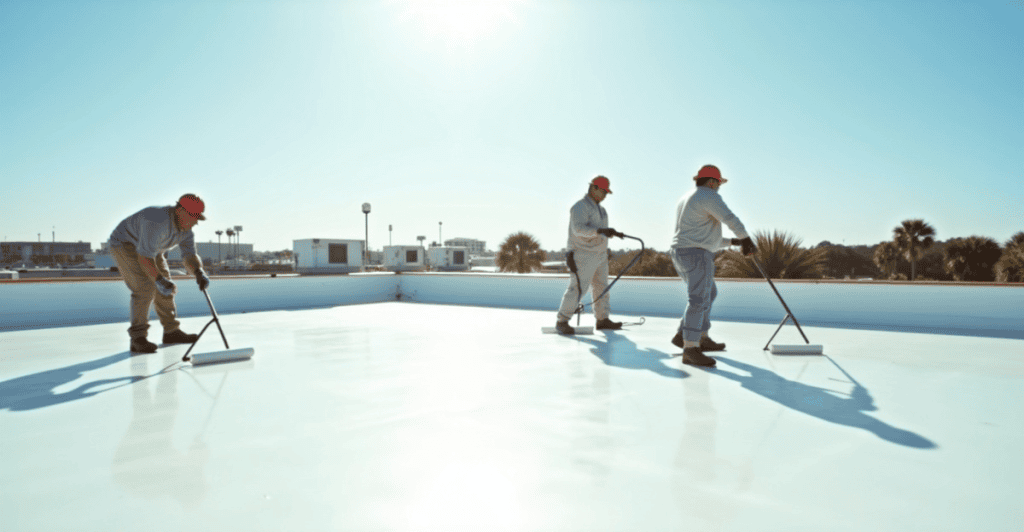
Step-by-Step Cost Calculation Example
To illustrate how these variables translate into an actual estimate, consider a 30,000-square-foot commercial warehouse with an aging, weathered EPDM roof membrane showing minor seam separation but dry insulation.
- Power Washing & Surface Preparation: $0.45 / sq. ft. = $13,500
- Seam Sealing & Flashing Detail Work: $0.65 / sq. ft. = $19,500
- Polyurethane Base Coat Application (15 mils): $1.80 / sq. ft. = $54,000
- Aliphatic Urethane Top Coat Application (15 mils): $1.85 / sq. ft. = $55,500
- Manufacturer 20-Year Warranty Inspection Fee: $0.15 / sq. ft. = $4,500
- Total Project Cost: $147,000
- Final Cost Per Square Foot: $4.90 / sq. ft.
- Comparable Tear-Off Cost ($12.00 / sq. ft.): $360,000
- Immediate Capital Savings: $213,000 (59% Savings)


